
What is a business strategy? If you’re running a business, it’s a question you should be asking yourself every day. A business strategy is more than just a set of plans—it’s the backbone of your company’s success. It tells you where you’re going and how you’re going to get there. Sadly, many people jump to conclusions — chasing quick wins and setting targets — without pausing for real strategic thinking. They skip the crucial first step: reflecting on the deeper questions that shape a winning strategy.
In this post, I’m going to break down exactly what is a business strategy, why it’s so important, and how you can build one that sets you up for long-term success. By the end of this, you’ll have all the tools you need to create your own strategy, make smarter decisions, and align your team towards your business goals.
Understanding What Is a Business Strategy
So what is a business strategy? A business strategy is a clear plan that outlines how a company will achieve its goals and gain a competitive edge. It’s about making smart choices — deciding what the business will do and, just as importantly, what it won’t do. Yet, many companies rush into action without careful thought, leading to missteps and missed opportunities.
To build a winning strategy, it’s not enough to focus solely on growth — you must first understand the pitfalls that could hold you back. Knowing what can cause failure is just as important as knowing what will drive success.
Why Most Business Strategies Go Wrong

The biggest reason why business strategies fail is the confusion between strategy and planning. Let’s break it down:
Planning focuses on listing activities and timelines — like launching a product, opening a new store, or hitting sales targets. It’s tangible and feels satisfying.
Strategy is all about making integrated choices — deciding which markets to target, which customer segments to serve, and how to differentiate yourself from competitors. It’s about crafting a theory for growth and aligning all actions to that vision.
However, here’s what often gets overlooked: planning should always come before strategy. Why? Because a solid plan helps you gather your thoughts, outline your goals, and identify the resources at your disposal. It creates clarity — and this clarity forms the foundation upon which you can build a focused, winning strategy.
Without strategic thinking, businesses end up with a disjointed plan — random initiatives that don’t connect back to a larger vision.
A classic example of strategic thinking is Southwest Airlines.
While other airlines focused on beating competitors with better service or amenities, Southwest took a bold strategic approach: they didn’t compete with other airlines — they competed with buses. Their strategy centred on providing low-cost, no-frills air travel, with choices like using only one type of aircraft and operating point-to-point routes. Every decision reinforced their core growth hypothesis: affordable, fast air travel.
This is what separates planning from strategy — every choice supports a bigger, long-term game plan.
The Core of a Business Strategy
Now that we’ve laid the groundwork with a solid plan, the next step is the core of it all — strategy.
Building a strategy isn’t easy. But the good news? When you’ve done your planning right, you’ve already done a huge chunk of the work in your head. You know your goals, your resources, and the direction you want to move in.
Strategy, then, is about taking those plans and digging deeper. It’s about connecting the dots — asking yourself the tough questions:
- Where will we play? — Which markets, customer segments, and geographies do we want to target?
- How will we win? — What will set us apart from competitors? What’s our unique value proposition?
- What must happen for this to succeed? — What key initiatives need to be in place to support our strategy?
Think of planning as deciding what mountain you want to climb — and strategy as figuring out the exact route, the gear you need, and the obstacles you must overcome to reach the summit.
The Best Business Strategy
So Really, What Is the Best Business Strategy?
The best business strategy is one that is both sustainable and scalable — and this often means combining organic and inorganic growth. While organic growth builds a solid foundation, the fastest-growing strategy by far is acquisitions.

Many business owners focus solely on organic growth — ramping up sales, expanding marketing efforts, and strengthening infrastructure — but they often overlook the power of inorganic strategies like acquisitions.
Rather than slowly building everything from scratch, acquisitions allow you to instantly expand your market share, customer base, and capabilities. Whether through horizontal integration (acquiring competitors) or vertical integration (absorbing parts of your supply chain), acquisitions create powerful synergies — reducing costs, streamlining operations, and enhancing overall business strength.
If your business already has solid systems, a strong team, and predictable sales and marketing processes, you’re in a prime position to pursue acquisitions. With the right guidance, you can identify potential targets, assess their value, and integrate them seamlessly into your business.
Ultimately, acquisitions don’t just accelerate growth — they enhance profitability. With stronger combined revenues and cost efficiencies, your EBITDA (Earnings Before Interest, Taxes, Depreciation, and Amortisation) improves, boosting your business’s valuation multiple. This means that whenever you decide to exit, you stand to gain far more than through organic growth alone.
How to Build a Winning Acquisition Strategy

If you’re serious about accelerating your business growth, building a strong acquisition strategy is key. But how do you create a winning plan for acquisitions?
The Mindset Shift: Why Acquisitions Should Be Part of Your Strategy
Many business owners have never considered acquisitions, not because they lack ambition, but because they simply don’t know how to start. It often comes down to two things:
- Lack of confidence — the fear of navigating uncharted territory.
- Lack of awareness — never realising the transformative power of acquisitions.
The truth is, acquisitions can be a gold mine. Once you successfully close one deal, it becomes easier to replicate the process, allowing you to scale faster than organic growth alone.
Laying the Foundation for a Winning Acquisition Strategy
To build an effective acquisition strategy, you need to start with a clear plan. Ask yourself:
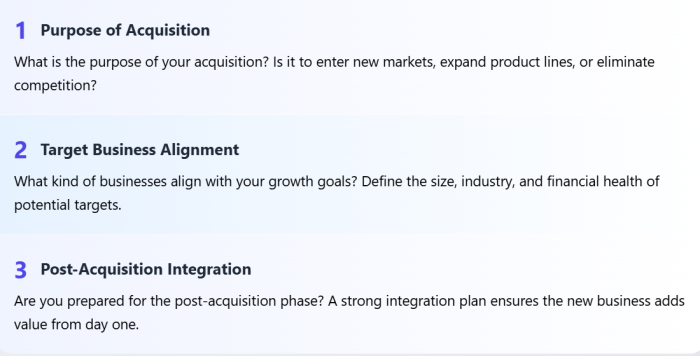
The beauty of inorganic growth is that it doesn’t stop at one deal. Once you have the right approach, acquisitions can become a repeatable process — unlocking new revenue streams, boosting profitability, and increasing your company’s valuation.
Unlock Your Acquisition Potential
I hope this post gave you a solid understanding of what is a business strategy and how to create one that works for your company.
And if you’re wondering why acquisitions haven’t been part of your strategy so far, it’s time to change that. With the right guidance, you can confidently explore and execute deals that transform your business.
Our team, with experience from top-tier companies like Unilever, Morgan Stanley, HSBC, and P&G, works alongside you — helping you understand the acquisition process, identify the right targets, and close deals seamlessly.
Let’s connect and craft a powerful acquisition strategy tailored to your growth goals. Reach out to us today — your next big breakthrough could be just one acquisition away.
Frequently Asked Questions (FAQ)
1. What is the difference between a business plan and a business strategy?
A business plan outlines what you want to achieve — goals, timelines, and tasks. A business strategy focuses on how you’ll achieve it — the choices you make about markets, customer segments, and competitive advantage.
2. Why is planning important before building a strategy?
Planning brings clarity. It helps you gather information, set goals, and understand your resources. Without this foundation, your strategy risks being disconnected from reality.
3. What is the most effective growth strategy for a small business?
Small businesses often start with organic growth — improving sales and expanding products. But to scale quickly, exploring inorganic options like partnerships or strategic alliances can create powerful momentum.
4. Can a business use both organic and inorganic growth strategies?
Absolutely! The most successful businesses strike a balance — using organic growth for stability and inorganic growth for rapid expansion.
5. How often should I review my business strategy?
Regularly — at least every quarter. Markets change fast, and your strategy should be flexible enough to adapt while staying aligned with your long-term vision.
Next steps…
Book a complimentary breakthrough business discovery call and gain the clarity you need to take your business forward →
