
The Blue Ocean Strategy is a framework for creating new markets by focusing on uncontested market space rather than competing in crowded, existing markets. Here are five steps to using the Blue Ocean Strategy to grow your business:
- Identify the market: The first step in using the Blue Ocean Strategy is to identify an untapped market or an existing market that can be redefined. This requires understanding your customers’ needs and preferences, as well as the competitive landscape.
- Eliminate factors that are not valuable to customers: The next step is to eliminate factors that are not valuable to customers. This could include features that are not used or that do not contribute to customer satisfaction.
- Reduce costs: The third step is to reduce costs in areas that do not impact customer value. This could involve streamlining processes or using lower-cost materials.
- Raise the value of key factors: The fourth step is to raise the value of key factors that customers care about. This could involve improving quality, adding new features, or offering better customer service.
- Create new factors: The final step is to create new factors that have not been offered before. This could involve developing new products or services or finding new ways to deliver value to customers.
Identify the market
Here are five steps to help a business owner identify new markets:
- Analyse existing customer data: The first step in identifying new markets is to analyse existing customer data to identify trends and patterns. This can help the business owner understand who their current customers are and what their needs and preferences are.
- Conduct market research: The next step is to conduct market research to identify potential new markets. This could involve surveying potential customers, analysing industry reports, or conducting focus groups.
- Monitor industry trends: Keeping up to date with industry trends can help a business owner identify emerging markets or shifts in consumer behaviour. This could involve attending industry conferences, reading trade publications, or following relevant blogs and social media accounts. There are also tools that can help a business monitor industry trends like Google Trends, Feedly and using Twitter hashtags to monitor industry trends.
- Explore adjacent markets: Exploring adjacent markets can help a business owner identify new opportunities for growth. For example, a business that sells organic skincare products could explore adjacent markets such as natural supplements or healthy snacks.
- Consider international markets: Finally, a business owner could consider expanding into international markets. This requires careful research and planning, including understanding cultural differences, local regulations, and logistical considerations.
Eliminate factors that are not valuable to customers
One way to determine factors that are not valuable to customers is to use the “eliminate-reduce-raise-create” (ERRC) grid. This tool helps businesses identify which factors in their industry they should eliminate, reduce, raise, or create in order to create a blue ocean strategy.
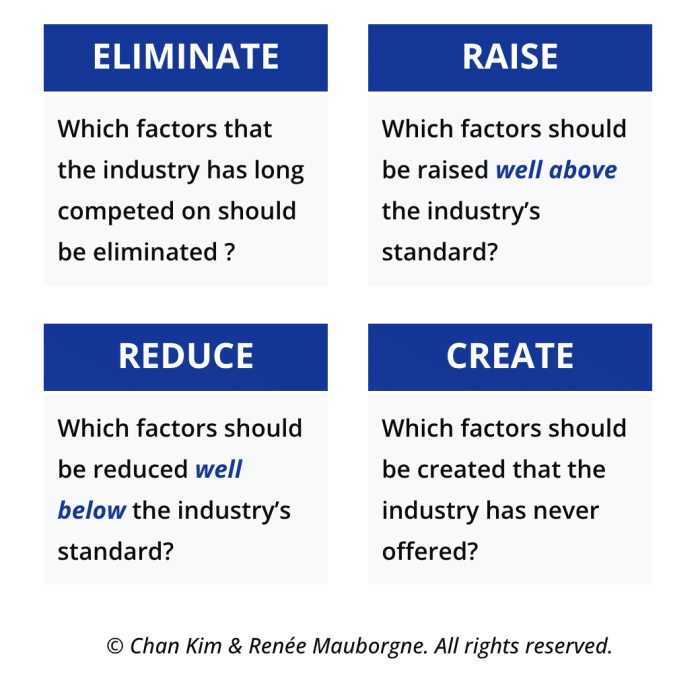
To determine which factors are not valuable to customers, businesses should focus on the “eliminate” quadrant of the ERRC grid. This involves identifying factors that customers do not value, but that businesses continue to offer. These factors may include product features that customers do not use or do not find important, or unnecessary steps in the production or delivery process that increase costs without adding value.
To identify these factors, businesses should conduct market research to understand what their customers care about and what they are willing to pay for. They should also analyse their own internal processes to identify areas where they may be overcomplicating things or adding unnecessary steps.
Once these factors have been identified, businesses can eliminate them from their offerings and focus on delivering the value that customers care about. This can help the business differentiate itself from competitors and create a blue ocean of uncontested market space.
By following these steps, businesses can create a unique value proposition and differentiate themselves from competitors. To successfully implement the Blue Ocean Strategy, businesses need to have a deep understanding of their customers, as well as a willingness to take risks and try new things.
Reduce costs
To reduce costs, businesses should focus on the “reduce” quadrant of the ERRC grid. This involves identifying factors that are important to customers, but that the business can reduce in order to lower costs. For example, a business may identify a particular product feature that customers value, but that is costly to produce. In this case, the business could look for ways to reduce the cost of producing that feature, such as by using a different material or production method.
To identify areas where costs can be reduced, businesses should conduct a thorough analysis of their internal processes and costs. They should look for areas where they may be overproducing, overcomplicating things, or adding unnecessary steps in the production or delivery process. This could include anything from reducing the number of product variations to optimizing their supply chain.
Once areas for cost reduction have been identified, businesses can focus on implementing changes that reduce costs without sacrificing value to the customer. This can help the business differentiate itself from competitors and create a blue ocean of uncontested market space.
Raise the value of key factors
To raise the value of key factors, businesses should focus on the “raise” quadrant of the ERRC grid. This involves identifying factors that are important to customers, and finding ways to increase their value. For example, a business may identify that customers highly value the speed of their product delivery, and can increase the value of this factor by offering even faster delivery times or implementing a more reliable tracking system.
To identify areas where value can be raised, businesses should conduct market research to understand what their customers care about and what they are willing to pay for. They should also analyze their own internal processes to identify areas where they can improve their ability to deliver value. This could include anything from improving the quality of their products to increasing the speed of their service.
Once areas for value enhancement have been identified, businesses can focus on implementing changes that increase the value of key factors for their customers. This can help the business differentiate itself from competitors and create a blue ocean of uncontested market space.
By following these steps, businesses can create a unique value proposition and differentiate themselves from competitors. To successfully implement the Blue Ocean Strategy, businesses need to have a deep understanding of their customers, as well as a willingness to take risks and try new things.
Next steps…
Book a complimentary breakthrough business discovery call and gain the clarity you need to take your business forward →
