
Elite athletes like Serena Williams don’t use coaches because they lack skill. According to sports psychology, they simply need an expert to monitor their blind spots while they are deep in the game.
You likely launched your company because you excel at your craft. Yet, industry data reveals that around the 12 to 24-month mark, almost every business owner hits the “Founder’s Ceiling.” Despite working harder than ever, you end up feeling stuck because raw talent alone can no longer drive your business growth.
Reaching this plateau is actually a sign of evolution, not failure. Top business coaches for entrepreneurs provide a crucial Outside Perspective Strategy-, -acting as dedicated partners who watch from the sidelines to help you see exactly what you are missing.
Summary
Entrepreneurs often hit a “Founder’s Ceiling” within 12–24 months, where effort no longer translates into growth; skilled business coaches provide the outside perspective to overcome blind spots. The guide clarifies coach vs consultant roles, shows how mentorship combats burnout through delegation and “Strategic Time Recovery,” and outlines UK market rates (£100–£300/hour) with a vetting framework to avoid scams. It explains how to measure ROI beyond vanity metrics, focusing on profit, retention, and quality-of-life and champions the shift from founder to CEO. A 30-day action plan closes the piece: diagnose bottlenecks, choose a coaching style, and vet three mentors.
The ‘Fishing’ Metaphor: Deciding Between a Business Coach and a Consultant
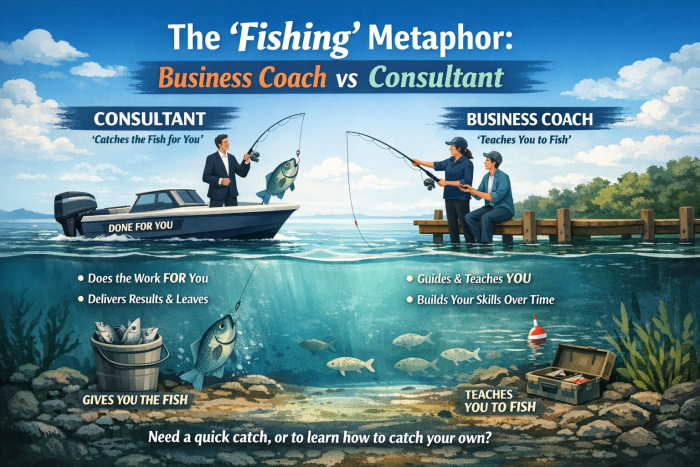
Realising you need external help is a huge milestone, but figuring out who to hire comes next. The easiest way to grasp the difference between business coach and consultant roles is the classic fishing metaphor.
A consultant catches the fish for you. If you run a bakery and need a custom inventory system built, you hire a consultant for “done-for-you” services. They execute the project and leave when the contract ends. This works perfectly when a small business needs immediate, specialised execution.
Conversely, business coaching operates on a “done-with-you” framework. Rather than writing your marketing plan for you, a coach helps you uncover your own blind spots to teach you how to fish. This builds internal leadership capabilities that heavily pay off in the long term because you retain the skills.
Weighing the ROI of outsourcing versus skill-building depends on your current growth stage. Deep exhaustion, rather than just feeling strategically stuck, signals a need for a different kind of support entirely.
Overcoming the ‘Sunday Night Dread’: How Mentorship Solves Founder Burnout
That familiar knot in your stomach on a Sunday evening isn’t just pre-week nerves; it’s a symptom of carrying your entire business alone. Many owners hit a ceiling where working harder simply stops working, leading to exhaustion instead of high performance.
Overcoming founder burnout with mentorship begins by identifying growth plateaus in small companies. An external sounding board helps you quickly spot three common roadblocks:
- The Time Trap: Drowning in administrative tasks instead of driving sales.
- The Hero Syndrome: The dangerous belief that nobody else can do the job right.
- The Cash Flow Fog: Operating on financial guesswork rather than clear numbers.
The hardest milestone for escaping this survival mode is learning to drop the Hero Syndrome. A capable coach helps you implement a simple “Decision Matrix,” allowing you to evaluate daily tasks by their financial impact and easily delegate low-value chores.
A powerful lever called Strategic Time Recovery emerges when you finally pass off these repetitive duties. By systematically handing off just a few minor operational tasks, you create a realistic plan to reclaim 10 hours of strategic time per week.
Proof of this system’s value becomes obvious when your workload drops. However, because the coaching industry remains wildly unregulated, protecting your investment requires knowing exactly who to trust.
Spotting the Real Deal: How to Find a Startup Mentor Without Getting ‘Ripped Off’
Anyone can print a card and claim to be an expert, making your search feel like a minefield. Red flags usually appear early, often disguised as “guaranteed 7-figure results” from flashy gurus lacking actual, real-world business experience.
Since you already know your current budget and goals, evaluating the cost of private business advisory services becomes much easier. Standard UK market rates typically fall between £100 to £300 per hour, though reputable experts usually require multi-month commitments to ensure lasting habits actually take root.
Figuring out how to find a startup mentor requires a strict vetting framework, starting with a short “Chemistry Session” to test personal fit. Whether you are hiring locally or browsing virtual business coaching platforms for startups, verify the qualities of a successful executive mentor by asking these five critical questions:
- Have you personally built a business in my industry?
- What specific framework will we use to measure my progress?
- Can you share a time your coaching failed, and why?
- How do we handle communication between our scheduled meetings?
- Are you willing to tell me directly when my ideas are terrible?
Securing the right partner quickly transforms the anxiety of spending money into the excitement of a strategic investment with measurable returns.
Measuring the ROI: How Professional Guidance Pays for Itself in 6 Months
Handing over hard-earned revenue for advice feels intimidating until you establish a clear three-step framework to track your return on investment. Start by measuring tangible financial gains alongside Quality of Life ROI, like reducing your weekend workload by ten hours.
Surface-level achievements like social media follower counts might feel rewarding, but these vanity metrics rarely pay the bills. True growth metrics focus on consistent profit margins and client retention, which remain the absolute baseline for measuring success in professional development coaching.
The real breakthrough actually happens inside your own head as you evolve from a reactive, stressed-out task manager into a proactive visionary. This critical evolution requires leaving the daily grind behind and successfully transitioning from founder to CEO mindset.
When you finally stop doing everything yourself, you create the necessary space for developing leadership skills and sustainable growth.
Your 30-Day Action Plan: Moving from Stagnation to Strategic Action
You no longer must navigate the lonely path of entrepreneurship alone. Equipped with these frameworks, you can confidently spot the difference between genuine guidance and expensive noise.
Use this starting point to grow your business over the next 30 days:
- Execute a 24-hour self-diagnostic to find your biggest bottleneck.
- Select a coaching style matching your needs, like strategic planning for first-time founders.
- Commit to evaluating three potential mentors.
Asking for help isn’t a weakness; it’s proof of your dedication. Take this first step to transform daily struggles into scalable success.
Frequently Asked Questions
1. What is the “Founder’s Ceiling,” and why does it hit around 12–24 months?
It’s a common growth plateau where working harder stops translating into results. Early traction often comes from your core craft, but as complexity increases you need systems, delegation, and clear numbers, not just effort. Hitting this ceiling is a normal sign of evolution, not failure, and an outside perspective helps you spot blind spots that are hard to see from inside the day-to-day.
2. Should I hire a business coach or a consultant?
Use the fishing metaphor. A consultant “catches the fish” for you with done-for-you execution (e.g., building a custom inventory system). A coach “teaches you to fish,” working done-with-you to uncover blind spots and build lasting leadership skills. Choose consultants for immediate, specialist outcomes; choose coaching to develop internal capability. If you’re deeply exhausted rather than just strategically stuck, mentorship is the better fit.
3. How does mentorship help with burnout and reclaim my time?
A coach acts as an external sounding board to diagnose three common roadblocks, the Time Trap, Hero Syndrome, and Cash Flow Fog. They’ll help you implement a simple Decision Matrix to rate tasks by financial impact and delegate low-value work. This unlocks Strategic Time Recovery: by handing off repetitive duties, you can realistically reclaim about 10 hours of strategic time per week, easing the “Sunday night dread” and shifting you from survival to growth.
4. How do I avoid getting “ripped off” when choosing a mentor, and what should I budget in the UK? \
Watch for red flags like “guaranteed 7-figure results” and a lack of real operating experience. Standard UK rates are typically £100–£300 per hour, and reputable coaches often require multi-month commitments to cement new habits. Start with a short Chemistry Session to test fit, and ask:
- Have you built a business in my industry?
- What framework will we use to measure progress?
- When has your coaching failed, and why?
- How do we communicate between sessions?
- Will you call out bad ideas directly?
5. How do I measure ROI and see coaching pay for itself within about six months?
Establish a clear baseline, then track both financial and quality-of-life gains. Focus on real metrics, profit margins and client retention, rather than vanity metrics like follower counts. Include Quality of Life ROI (e.g., reducing weekend work by 10 hours) to capture reclaimed strategic time. With consistent tracking and action, the combination of higher profit/retention and recovered time can offset fees within roughly six months while advancing your shift from founder to CEO.
Next steps…
Book a complimentary breakthrough business discovery call and gain the clarity you need to take your business forward →
